Sector study · Networks
What to renew, which deliverable to accept.
For water, energy and telecom, the decision has the same shape. Fibre (FTTH) is one telecom example inside that shape. It is not the subject of the study.
Author : Youcef ADDA (GEODECI) ·
One decision, three families of networks
Drinking water, wastewater, electricity, gas, heat and telecom all ask: what to renew or repair first, which deliverable to accept, where the asset register is not yet reliable enough, and where to survey first.
Since 1 Jan 2026, where a PCRS exists, it is the basemap for DT-DICT replies. Sensitive networks in class A, and non-sensitive networks in urban areas, are in the same calendar. The fundable answer is a ranked survey programme, not a promise to survey everything.

Five decisions
01
Accept or refuse a deliverable
- Who decides
- Client, owner’s engineer, integrator, engineering firm.
- If it goes wrong
- Paying for a wrong deliverable, field rework, a dispute.
- Information required
- Conformity to the business reference, engineering rules, consistency with the field.
- Criterion to write
- An acceptance grid you can stand behind, with blocking and non-blocking thresholds.
For telecom, the current exchange reference is GraceTHD.
02
Rank renewal or maintenance
- Who decides
- Operations director.
- If it goes wrong
- Outages, poorly targeted interventions, penalties.
- Information required
- Condition of the assets, incidents, how critical the users are.
- Criterion to write
- Criticality by probability, drawn on the map.
03
Prepare the end of the contract
- Who decides
- Local authority, or the granting body.
- If it goes wrong
- Assets that cannot be operated, and a rebuild paid by the authority.
- Information required
- Completeness, quality, history of changes.
- Criterion to write
- A completeness inventory, followed over time.
Water, energy or telecom concession: the question is the same.
04
Programme the surveys
- Who decides
- Operator, local authority.
- If it goes wrong
- Damage, liability.
- Information required
- Precision class, PCRS already available, works already programmed.
- Criterion to write
- A ranked survey programme.
05
Telecom example: validate a copper-to-fibre migration zone
- Who decides
- Local authority, operator.
- If it goes wrong
- Subscribers without an alternative, disputes.
- Information required
- Real connectability at the address, failed connections.
- Criterion to write
- Address completeness, checked zone by zone.
This fifth decision is specific to telecom. The four above are not.
Why the tools fall short
- Checks done by hand, at the end of the works, dependent on one person.
- Engineering rules that stay implicit, and differ from one subcontractor to the next.
- Data scattered across versions and formats.
- No trail of who changed what, so a choice is hard to defend.
Criterion, check, trail, choice
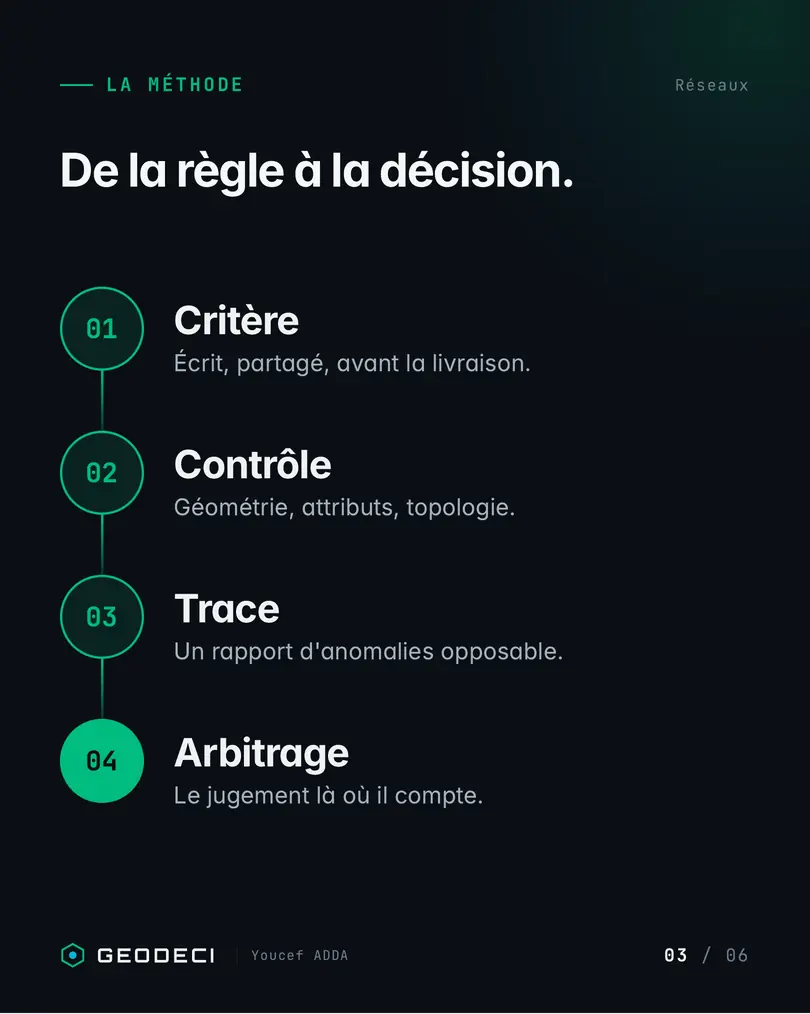
- 01
State the decision
Who decides, on what, and with what tolerance for risk.
- 02
Write the criteria
Readable by a person, executable by a machine.
- 03
Check continuously
Deliverable by deliverable, not only at the end of the works.
- 04
Keep the trail
Each anomaly, each correction, each accepted waiver.
- 05
Decide
The person decides. The report says why.
- 06
Hand it over
Rules and data stay with the client.
QGIS, PostGIS, automated checks, a change journal. An AI can be used. It stays reviewed by a person.
Telecom, as an example
GraceTHD v3 is the exchange model for fibre network data. Deliverables are returned in that structure. Older datasets are migrated into it.
At the end of a public-service contract, the authority takes the infrastructure and its data back. If the data is incomplete, rebuilding it stays on the authority’s side of the bill.
Arcep has started the commercial closure of the copper network. A fibre alternative then has to be true at the address. That check is a telecom decision. The method around it is the one used for water and energy.

90 days on one decision
- 01
Days 1 to 30
Pick one priority decision, map the data, write the criteria grid.
- 02
Days 31 to 60
Check a pilot batch, measure the gaps, adjust the thresholds.
- 03
Days 61 to 90
Generalise. Put the trail and the dashboard in place. Train the team.
Sources
- Arcep, copper network closure (opens in a new tab)
- ANCT / AVICCA note, GraceTHD v3 (opens in a new tab)
- PCRS, regulatory context (docs.pcrs.beta.gouv.fr) (opens in a new tab)
- Order of 15 February 2012, DT-DICT (Légifrance) (opens in a new tab)
- Order of 26 October 2018 (Légifrance) (opens in a new tab)
Youcef ADDA (GEODECI)
Decision Diagnostic
A short fixed scope. We name what costs money or blocks the work, and the first action to take.